
Hanlon’s Razor, and the Third Explanation Nobody Considers
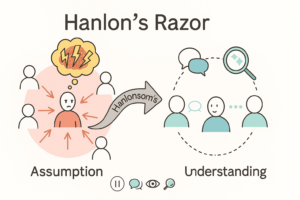
A project manager I’ll call Marco once spent two weeks convinced that the infrastructure team was sitting on his change requests on purpose. The tickets went in, nothing moved, and every status meeting ended with the same vague “we’re looking at it.” By the second week he had a theory involving an old budget dispute and a team lead who didn’t like him. Then someone checked the ticket routing. His requests were landing in a queue that nobody had monitored since a reorganization four months earlier.
That gap between the story we tell ourselves and the boring explanation is what Hanlon’s Razor is about.
The rule and where it came from
The usual phrasing is: “Never attribute to malice that which can be adequately explained by stupidity.” The name comes from Robert J. Hanlon, who submitted the line to Arthur Bloch’s Murphy’s Law Book Two: More Reasons Why Things Go Wrong in 1980. It was a joke book. The idea stuck anyway, probably because most people recognize the mistake it describes.
Hanlon wasn’t the first to say it. Goethe has a version in The Sorrows of Young Werther (1774): misunderstandings and lethargy, he writes, may do more harm in the world than deceit and malice. Robert Heinlein put something similar in a character’s mouth in the 1941 story “Logic of Empire,” accusing someone of blaming villainy for conditions that come from stupidity. The “razor” label borrows from Occam’s Razor, the old preference for the explanation that needs the fewest assumptions. Malice requires a motive, a plan, and someone willing to carry it out. Incompetence requires only a normal human being on a normal bad day.
I’d change one word in Hanlon’s version. “Stupidity” makes it sound like the alternative to a villain is an idiot. In my experience the more common explanation is neither.
Why the worst interpretation feels so natural
There’s decent research on why we jump to hostile explanations. The fundamental attribution error, named by Lee Ross in 1977, describes our habit of explaining other people’s behavior through their character while explaining our own through circumstances. When I miss a deadline, it’s because three priorities collided. When you miss one, it’s because you don’t care.
A more specific version is hostile attribution bias: reading hostile intent into situations that are ambiguous. Kenneth Dodge’s work in the early 1980s showed that aggressive children were much more likely to interpret an ambiguous accident (a peer bumping into them, say) as deliberate. A 2002 meta-analysis by Orobio de Castro and colleagues in Child Development, pooling 41 studies, found a consistent link between hostile attribution and aggressive behavior. Most of that research is on children and adolescents, so I’d be careful about stretching the effect sizes to a corporate steering committee. The mechanism, though, will look familiar to anyone who has read a two-line email from a stakeholder three times looking for the insult.
There’s also an evolutionary argument. Martie Haselton and David Buss’s error management theory (2000) suggests that when two kinds of error carry very different costs, natural selection favors the bias toward the cheaper error. Mistaking a friend for a threat costs you some awkwardness. Mistaking a threat for a friend can cost much more. So suspicion is cheap insurance. The trouble is that in an office the costs flip. Treating a colleague as an enemy is rarely cheap, because they usually notice and respond accordingly.
The third explanation
Here’s where I think the razor, as usually stated, falls short. It offers two options: malice or incompetence. In organizations, the most common cause of behavior that looks hostile is a third thing. The system made it happen.
Take Marco’s queue. Nobody was malicious and nobody was particularly incompetent. A reorganization moved a team, the routing rules didn’t follow, and each person involved was doing their job correctly inside a broken setup. The same goes for the colleague who never answers your messages because their manager measures them on ticket closure and your request isn’t a ticket, or the vendor who keeps missing milestones because the contract pays on delivery of documents rather than working software.
Blaming incompetence in those cases is almost as unhelpful as blaming malice. Both focus on the person. If you replace the person and keep the system, you get the same behavior from the next one. W. Edwards Deming made a version of this argument decades ago, estimating that the large majority of quality problems came from the system rather than the workers. His exact percentages (he cited figures between 85 and 94 percent in different places) were closer to professional judgment than measurement, so I wouldn’t lean on the numbers. The direction is right.
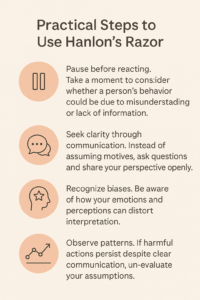
So my working version of the rule is longer and less quotable: before assuming someone is acting against you, check whether they’re simply missing information, and before assuming they’re missing information, check whether the setup around them is producing exactly what you’re seeing.
Where the razor fails
The razor is a default, not a verdict, and it can be abused in two directions.
The first is that some people really are acting in bad faith. Politics, competition for budget, a manager protecting their turf: these happen. If you’ve explained the problem clearly, the person has acknowledged it, and the behavior continues in exactly the way that benefits them, then the innocent explanation is becoming the one with more assumptions. Occam starts pointing the other way.
The second abuse is quieter. “They didn’t mean it” can become an excuse to avoid an uncomfortable conversation. Repeated carelessness that keeps hurting the same people is still a problem, whatever the intent. Negligence isn’t malice, but at some point the distinction stops mattering to the person on the receiving end. Hanlon’s Razor tells you how to interpret behavior. It doesn’t tell you to tolerate it.
And there’s an honest limit to my own argument. I don’t know how well the “check the system first” approach holds in small organizations, where there’s less structure to blame and personal dynamics carry more weight. Most of what I’ve seen comes from large programs with many teams and many handovers, which is exactly where structural explanations are most likely to be true.
In practice
What I actually do when I catch myself building a malice theory is ask a fairly dull question: what would this person need to know, or have, for this not to happen? Usually the answer points to something specific and fixable, like a missing brief, a conflicting priority their manager set, or a queue nobody is watching. Asking that question directly (“I noticed the requests haven’t moved, is something blocking them on your side?”) costs one awkward message. Acting on the malice theory costs a working relationship, and sometimes the project timeline along with it.
Marco’s tickets cleared in two days once the routing was fixed. The team lead he suspected was mildly confused about why the two of them had been so tense.
Sources:
- Ross (1977), Dodge (early 1980s; the 1980 paper in Child Development is the usual anchor),
- Orobio de Castro et al. (2002, Child Development 73(3)),
- Haselton & Buss (2000, Journal of Personality and Social Psychology),
- the Heinlein story, and the Werther passage (letter of 4 May)